

About the Norfolk Craft Guild
Established in 1952 by member charter, originally known as the Norfolk Rural Craftsmen’s Guild, and for many years now – the Norfolk Craft Guild – it was established to promote, support, and preserve the practices and techniques of skilled craftsmanship in Norfolk and the surrounding East Anglia region.
Having emerged at a time when post-war Britain – in an era of modern industrialisation – was also yearning to experience a renewed appreciation for traditional and handmade work and traditional skills – these principles and values continue to define the Guild to this day.
The Norfolk Craft Guild was formed by a group of local master artisans who recognised the need for an organisation that would nurture high-quality local craftsmanship, encourage collaboration, and provide opportunities for these multi-talented creatives to exhibit and develop their work. Inspired by the traditions of medieval craft guilds – which served as both protectors of trade standards and communities for skilled makers – the Norfolk Craft Guild built on this heritage while embracing the needs of contemporary craft in the modern world.
From its earliest days, the Guild attracted talented craftspeople from across the county – ceramicists, woodturners, weavers, jewellers, bookbinders, leatherworkers, and more – many of whom were at the forefront of the British craft revival of the mid-20th century. Their passion and dedication laid the foundation for what would become one of Norfolk’s most respected creative communities.
The first President of the Guild was Lilias Rider Haggard MBE, who was notable for her status in the County of Norfolk, having served on Norfolk County Council, and having written many notable books about Norfolk Life – an inherited family trait it seems – as her father Sir Henry Rider Haggard KBE was the author of popular bestselling novel “King Solomon’s Mines”. Whilst it is not believed that Lilias herself practiced any crafts, her respected local reputation likely contributed to her involvement and support towards preservation of the local and rural traditional skills.
Another notable founder member of the Guild was the legendary Eric Stevenson, a master blacksmith from Wroxham, who worked on the ironwork gates of St Pauls Cathedral in London – in fact – Eric was the first person to work on them since they were first installed in 1698. Amongst Eric’s other notable work was the Spider Gate at Hoveton Hall in Norfolk, the altar rails for St Martin in the Fields, London, the screen at St Nicholas Church in Great Yarmouth, and ironwork at Norwich Cathedral and also many local village signs across Norfolk including Wroxham, where he lived.
At the 1956 Royal Norfolk Show, which was held at Anmer near the Sandringham Estate at that time, his stand was visited by the late Queen Mother and Princess Margaret, and a fire screen made by Eric was purchased by the Sandringham Estate.
On July 2 1970, after 40 years at the anvil, Eric was awarded the ‘Gold Medal and Freedom and Livery’ of the Worshipful Company of Blacksmiths (a highly prestigious Livery Company of the City of London) by Mr Joseph Diamond, prime warden of the company, at Innkeeper’s Hall in the City of London. It was the first ceremony to be filmed in the Worshipful Company’s 600-year history.
Past members used to be able to display the Guild emblems (featured right) – the only one of these still known to be in existence was recently re-discovered by our Chair of the Guild.
Whilst not much more detail is currently known about the early history and origins of the Norfolk Craft Guild, this is being actively researched to help preserve the legacy of the Guild.


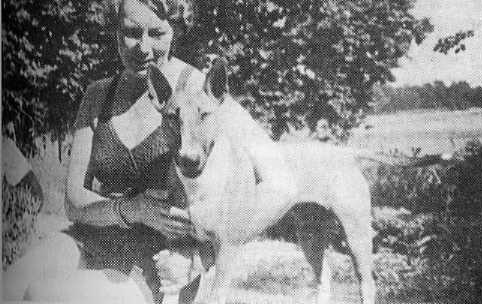
Lilias Rider Haggard MBE, the first President of the Guild.
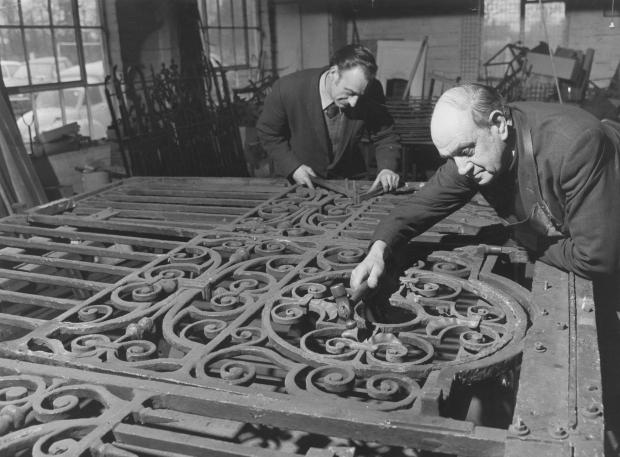
Eric Stevenson, founder member and master blacksmith – pictured working on the ironwork gates of St Pauls Cathedral, London – the first person to work on them since they were first installed in 1698.
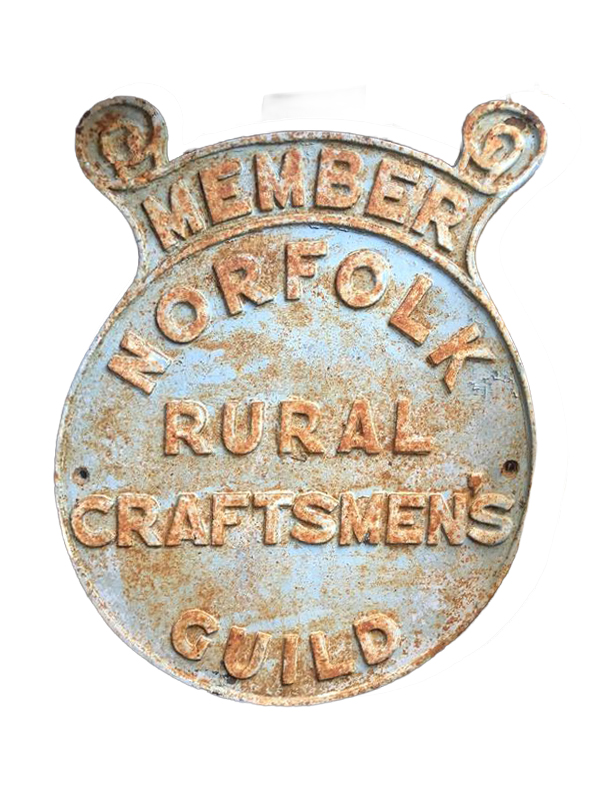
A guild emblem – these metal insignia were previously used by members of the Guild to showcase their proof of membership, the attainment of the highest standards of their craft, quality assurance as a seal of approval and for the protection of the members’ intellectual property, and as a demonstration of pride, status and professionalism.


Our Heritage and the Craft Guild Tradition
The idea of a “craft guild” has deep historical roots. In medieval times, guilds were associations of artisans and merchants who oversaw the practice of their trade in a particular area. They ensured high standards, provided training through apprenticeships, and offered mutual support and protection.
The Norfolk Craft Guild carries forward many of these principles – particularly the commitment to excellence, the sharing of knowledge, and a strong sense of community among makers.
While rooted in tradition, the Guild has evolved with the times. It has welcomed new materials, technologies, and forms of expression while staying true to its original mission: to uphold and promote the highest standards of craftsmanship in Norfolk.
The Norfolk Craft Guild has exhibited at many prestigious venues including for many years at the National Trust Blickling Hall Estate, The Forum Norwich, Becket’s Chapel (Gallery) in Wymondham, and in recent years too at the Handa Gallery in The Maltings, Wells-next-the-Sea.
Membership and Assessments
Membership in the Guild is by assessment, reflecting our commitment to quality and integrity in all forms of craft.
New applicants present their work either at the regularly held Guild Committee meetings or at the Annual General Meeting (AGM), where it is reviewed by a panel of the Guild’s Executive Team, for quality, creativity and technique. Feedback is constructive, and the process ensures that every member shares the Guild’s values of skill, creativity, and dedication to their craft.
The Guild also operates under a clear and democratic constitution, which outlines its purpose, governance, and code of ethics. This includes the formal Annual General Meeting (AGM), where members gather to reflect on the past year, elect Executive team, officers and committee members, and plan future exhibitions, workshops, collaborative projects and occasionally social events too.


